What the Iran War and oil crisis mean for Vietnam's manufacturing industry.

The ongoing war involving Iran has triggered one of the most severe global energy disruptions in decades, with consequences that are being felt most acutely across Asia; in particular, within manufacturing hubs like Vietnam. For industries such as backpacks and outerwear, which sit at the intersection of petrochemicals, global logistics, and labor-intensive production, the impact is both immediate and deeply structural.
A Historic Oil Supply Shock Hits Asia First
At the center of the crisis is the disruption of the Strait of Hormuz, a critical maritime chokepoint through which a significant share of global oil supply flows. For Asia, the exposure is especially acute, with the majority of imported crude oil transiting through this route.
Approximately 80% to 90% of the oil exported through the Strait of Hormuz is destined for Asian markets. With about 20 million barrels per day of total oil flowing through the strait in 2025, it serves as the critical energy artery for major Asian economies, including China, India, Japan, and South Korea, which receive over half their crude from this route.
With supply constrained and geopolitical risk premiums rising, oil prices have surged dramatically. This is not just a headline issue for energy markets; it is a foundational shock that feeds directly into manufacturing economies.

Vietnam’s Structural Vulnerability
Vietnam is particularly exposed due to its reliance on imported energy and relatively limited strategic reserves. As fuel costs rise, the country faces:
Increased electricity and industrial energy costs
Higher inland transportation expenses
Currency and financial pressure from rising import bills
For export-driven manufacturing sectors like backpacks and outerwear, this creates an immediate and unavoidable cost burden.
Petrochemical Shock: The Hidden Cost Driver
Backpack and outerwear production is heavily dependent on petroleum-derived materials. Crude oil price increases are transmitted into manufacturing primarily through what is called “naphtha cracking chains”, which produce the base polymers used across textile and component production.
As crude oil prices rise, the cost of upstream petrochemical feedstocks, such as naphtha, also increases. This cascades through the entire material supply chain, driving up the cost of nearly every core component used in manufacturing.
Key upstream pathways:
Crude oil → Naphtha
Naphtha → Ethylene / Propylene
Derivatives:
Polyester (PET) via PTA + MEG
Nylon (PA6 / PA66) via caprolactame / adipique acid
Polyurethane (PU) via MDI / TDI systems
EVA foams via ethylene-vinyl acetate copolymers
Plastics used in trims, hardware, and packaging
A sustained increase in crude oil pricing, of let us say +40–60% typically results in:
+25–45% increases in polymer resin pricing
+20–40% increases in filament yarn costs
+15–35% increases in finished fabric costs (depending on construction and finishing complexity)
These increases are not uniform, but vary based on:
Polymer type (nylon is typically more volatile than polyester)
Regional production capacity constraints
Energy intensity of downstream processing
For factories producing technical products, substitution is often limited. Performance requirements, such as water resistance, durability, weight, and hand feel, mean that cheaper alternatives are often not viable options.

Supplier Price Increases: How Oil Costs Flow Into Factory Pricing
One of the most immediate and tangible impacts for manufacturers in Vietnam is the wave of price increases from material suppliers.
Direct Cost Pass-Through
Material suppliers, such as fabric mills, coating facilities, and trim manufacturers, operate on cost structures that are tightly linked to oil-derived inputs. As their raw material costs increase, they pass these increases downstream to factories in the form of:
Higher fabric prices, often revised monthly instead of quarterly
Surcharges on coatings and laminations
Increased minimum order quantities so as to maintain production efficiencies
For example:
A nylon fabric supplier facing a 20–30% increase in polymer costs will typically pass through a large portion of that increase within one pricing cycle
PU coating suppliers may introduce temporary “energy surcharges” tied directly to fuel and electricity costs
Shortened Price Validity Windows
Historically, suppliers might hold pricing for 60–90 days. In the current environment:
Quotes are often valid for 7–30 days only
Some suppliers require price reconfirmation at order placement
Long-term contracts are being renegotiated or temporarily suspended
This creates planning instability for factories, especially those working on forward orders with fixed FOB pricing.
Layered Cost Amplification
The critical nuance is that cost increases are not linear, they are compounded across multiple tiers:
Oil price increases
Petrochemical feedstock costs rise
Yarn and polymer producers increase prices
Fabric mills adjust pricing
Coaters and laminators add surcharges
Trim suppliers (buckles, zippers, webbing) follow suit
By the time materials reach a backpack factory, the cumulative increase can be significantly higher than the initial change in oil prices would suggest.
A technical backpack or outerwear garment typically has the following cost composition at the factory level:
Component Category % of FOB Cost Oil Sensitivity
Fabrics (shell/lining) 30–45% High
Trims (zippers, buckles) 10–20% High
Foams & padding 5–10% High
Coatings/lamination 5–15% Very High
Labor 15–25% Indirect
Overhead & energy 5–10% High
Over 60–70% of a backpack’s material cost base is directly or indirectly linked to petroleum-derived inputs.
Limited Negotiation Leverage
Factories, especially OEM/ODM suppliers in Vietnam, often have limited ability to negotiate these increases because:
Suppliers themselves are operating under margin pressure
Demand remains relatively strong for key materials
Switching suppliers mid-season is operationally risky
As a result, factories are forced to absorb costs or attempt to pass them on to brands, which is often met with resistance.
Supplier Price Escalation Mechanics
a) Polymer & Yarn Producers
Adjust pricing weekly or bi-weekly based on feedstock indices
Introduce floating pricing mechanisms tied to naphtha benchmarks
Reduce credit terms to preserve cash flow
b) Fabric Mills
Cost increases are driven by:
Yarn input cost increases
Dyeing & finishing energy costs (steam, electricity)
Chemical input costs (also oil-derived)
Typical adjustments:
Fabric price increases of +10–25% within a single quarter
Elimination of long-term price locks
MOQ increases to maintain machine efficiency
c) Coating & Lamination Suppliers
This is one of the most impacted segments due to heavy reliance on PU systems:
PU resin costs can spike by +30–50% in volatile markets
Solvent and adhesive systems become supply-constrained
Factories introduce:
Energy surcharges
Chemical surcharges
Reduced capacity allocation for low-margin customers
Logistics Disruption: Shipping Costs and Delays
Beyond materials, the conflict is also disrupting global shipping routes:
Increased risk and insurance costs in key maritime corridors
Vessel rerouting leading to longer transit times
Volatility in freight rates
For Vietnam-based manufacturers, this results in:
Delays in inbound raw materials
Increased export costs
Greater working capital requirements to buffer uncertainty
Margin Compression Across the Supply Chain
The combined effect of rising material, energy, and logistics costs is severe margin compression.
Factories are squeezed from both sides:
Upstream suppliers are raising prices
Downstream brands are resisting price increases
This is particularly acute in the backpack and outerwear sector, where:
Margins are already tight
Products are cost-sensitive
Orders are often placed months in advance at fixed prices
Strategic Shifts Already Emerging
The current crisis is accelerating several structural changes:
Diversification of Material Sourcing
Factories and brands are exploring alternative supply bases and recycled materials, though these remain indirectly tied to oil pricing.
Inventory Buffering
Brands are increasing safety stock to hedge against delays and price volatility.
Supplier Relationship Prioritization
Stronger partnerships are becoming critical to secure allocation and stable pricing.
What This Means for Backpack & Outerwear Brands
For brands sourcing from Vietnam, the implications are clear:
Expect frequent and unpredictable material price adjustments
Build flexibility into costing and quoting processes
Allow for longer lead times and buffer capacity
Strengthen supplier collaboration and transparency
Perhaps most importantly, brands must recognize that this is not a temporary anomaly. The tight linkage between oil, petrochemicals, and manufacturing inputs means that volatility at the energy level will continue to cascade through the system.
Conclusion
The war in Iran has exposed a fundamental vulnerability in global manufacturing: its dependence on stable, affordable energy. For Vietnam’s backpack and outerwear industry, the impact is cascading, from oil markets to petrochemicals, from suppliers to factory floors.
The sharp rise in supplier pricing is not an isolated issue; it is the clearest expression of how deeply oil is embedded in the manufacturing ecosystem. As costs ripple through each layer of the supply chain, adaptability, transparency, and strategic alignment between brands and manufacturers will be essential.
In this environment, resilience is no longer about efficiency alone—it is about the ability to absorb shocks, adjust quickly, and navigate uncertainty across every tier of production.

Kowide Outdoors – Who We Are
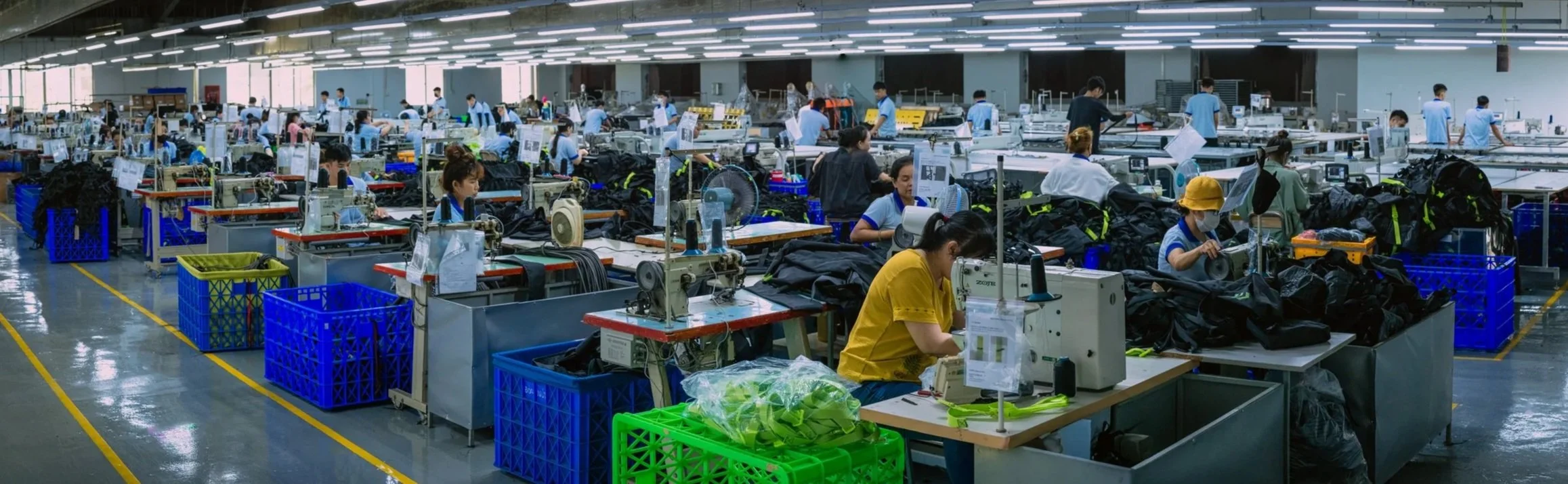
We specialize in OEM backpack manufacturing, technical outerwear production, and Vietnam-based supply chain solutions for global brands. from Taiwan, operating as both a custom backpack manufacturer and a trusted outerwear manufacturer for global brands.
A leading OEM manufacturer with over 50 years of experience supplying products to world-renowned brands across Europe, Asia, Australia, and North America. Our world-class production facility in Vietnam, situated within easy reach of Ho Chi Minh City, is ideally suited to cover all manufacturing needs, from R&D, sourcing, and prototyping to bulk production.
Through technical expertise, ethical management, and rigorous quality control, Kowide Outdoors consistently strives to exceed client expectations, taking pride in helping clients achieve success by delivering the highest level of quality and unparalleled customer service.