As the outdoor industry evolves, so do the fabrics behind it. Here's what every brand, designer, and sourcing manager should know about sustainable materials in 2026.

The outdoor industry has long prided itself on a deep respect for the natural world, and yet, for decades, the materials used to make backpacks have told a different story. Virgin nylon, petroleum-derived polyester, and PFC-based waterproofing treatments have dominated the market not because they were ideal, but because they were cheap, reliable, and easy to source at scale.
That calculus is changing. Brands, consumers, and manufacturers alike are demanding more sustainable alternatives, and the good news is that those alternatives have matured significantly. At Kowide Outdoors, we've spent years sourcing and working with eco-friendly fabrics across our Vietnam production facility, and this guide represents our most current thinking on the materials that matter.
"Sustainability isn't a trend in technical fabrication; it's a material shift in how the entire supply chain thinks about value." – Kowide Outdoors
Why fabric choice is the most important sustainability decision
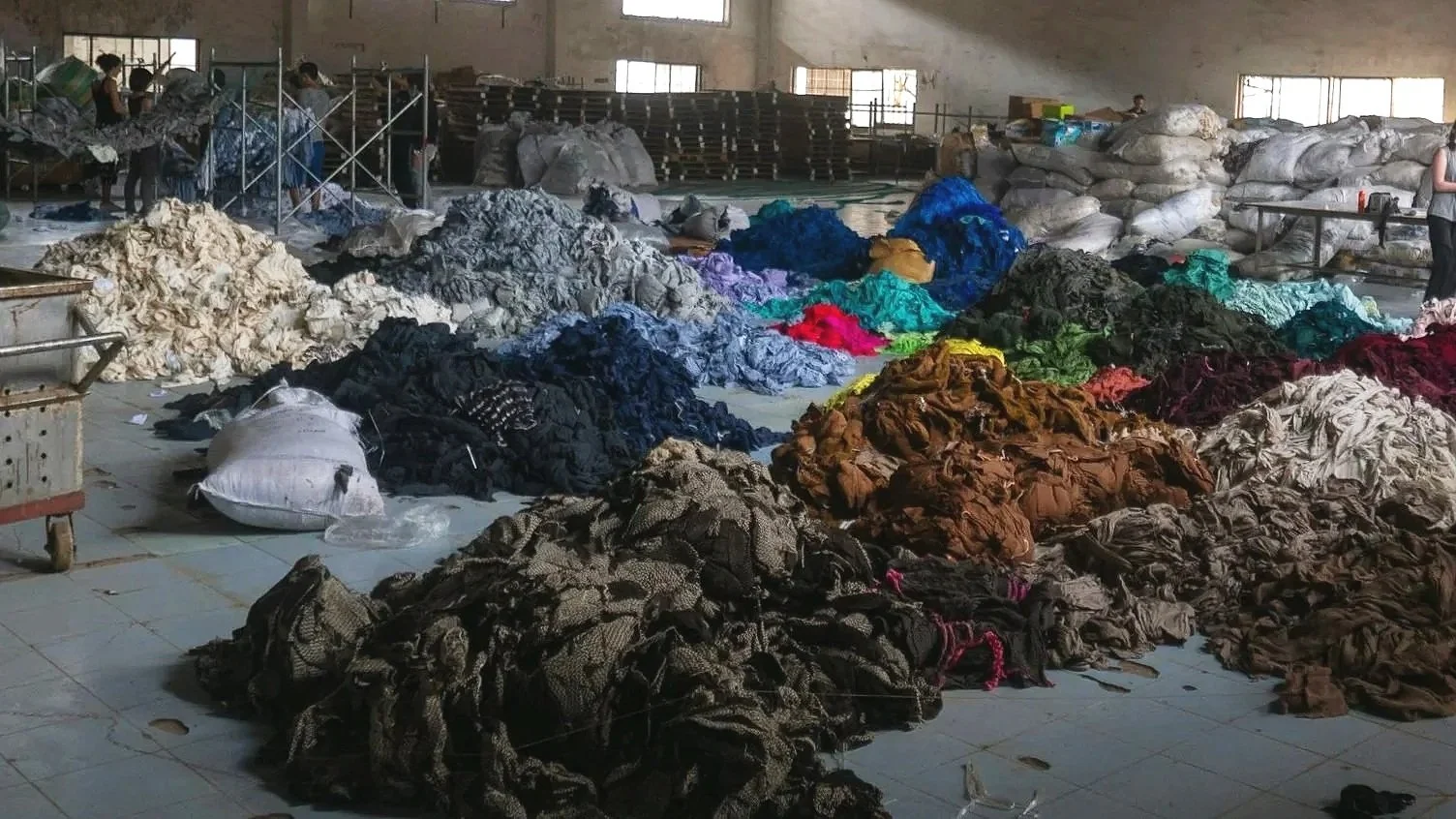
When people talk about sustainable backpacks, they often focus on the finished product, recycled labels, minimal packaging, and carbon offset programs. These matter, but they're downstream from the most consequential choice of all: the fabric.
Fabric accounts for the majority of a backpack's environmental footprint. It determines energy use in production, water consumption, chemical inputs, end-of-life recyclability, and longevity in the field. Choose well here, and every downstream impact improves. Choose poorly, and no amount of greenwashing will fix it.
The leading eco-friendly fabrics we work with
Below is a practical breakdown of the most viable sustainable fabrics available for backpack production today, their strengths, trade-offs, and best-fit applications.
Recycled Nylon (rNylon) - High performance
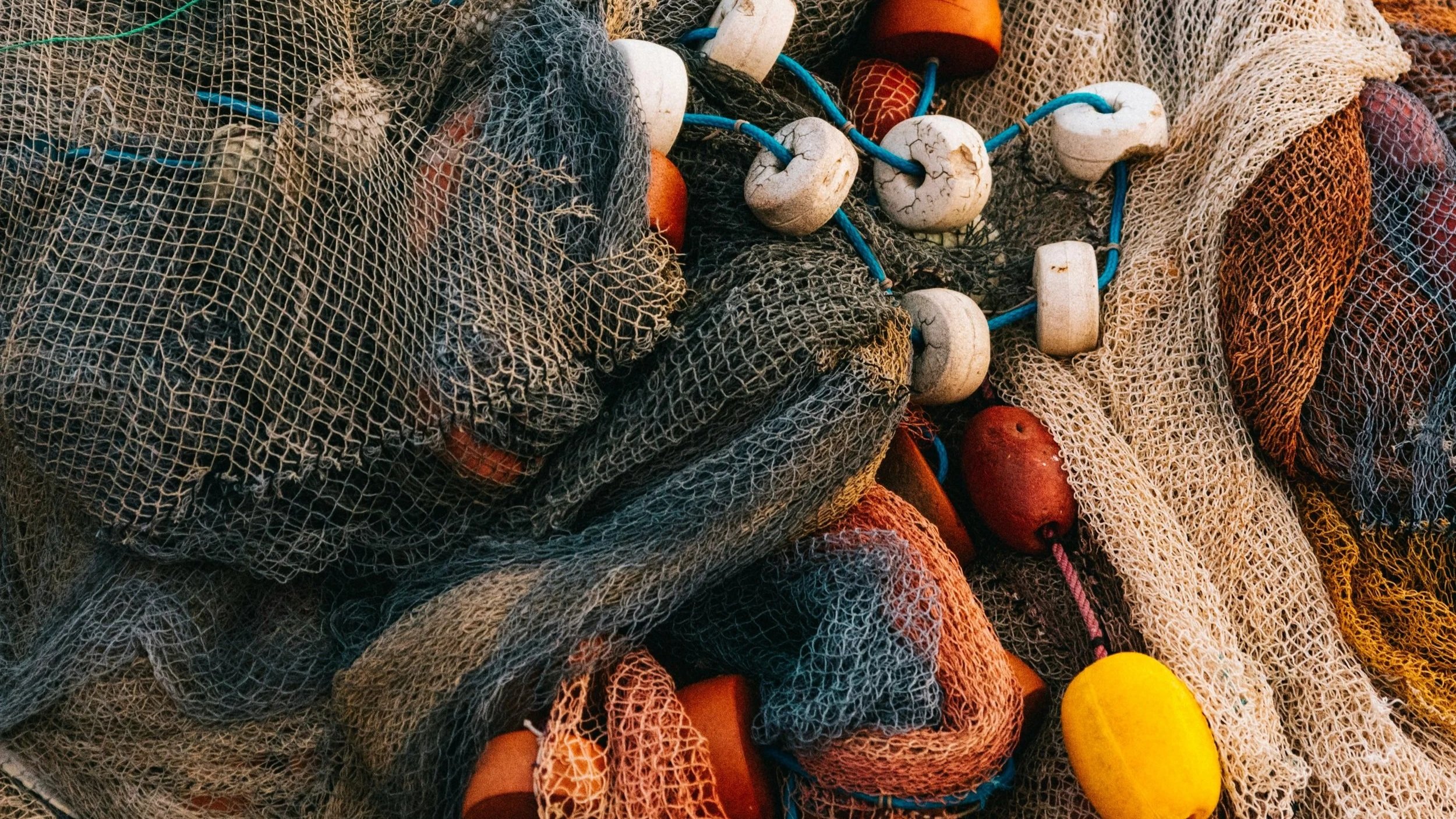
Made from post-consumer waste like fishing nets and industrial scraps. Retains the performance of virgin nylon with 80% lower carbon emissions.
Recycled Polyester (rPET) - Cost-effective
Derived from post-consumer PET bottles. Reduces energy use by 30–50% versus virgin polyester and keeps plastic out of landfills.
Organic Cotton Canvas - Natural & biodegradable
Grown without synthetic pesticides or fertilizers. Ideal for lifestyle and urban packs where technical performance demands are lower.
CORDURA re/cor™ (Leejo Tex) - Ultra-durable recycled
CORDURA®'s recycled fabric portfolio, available through Leejo Tex, is made from pre- and post-consumer recycled polyester and nylon. It delivers the same legendary CORDURA® durability with a significantly reduced environmental footprint, GRS-certified.
Tencel™ / Lyocell - Closed-loop process
Wood pulp-derived fiber is produced in a closed-loop solvent process. Soft, breathable, and certified biodegradable under industrial conditions.
Bio-based Nylon - Next-generation
Emerging fiber derived from castor oil or corn fermentation. Reduces fossil fuel dependency while matching the mechanical properties of conventional nylon.
NetPlus® Recycled Fishing Net Nylon (Gelanots) - Ocean-sourced & traceable
A 100% recycled nylon 6 made from reclaimed fishing nets, developed by Gelanots (Toyota Tsusho) in collaboration with Bureo®. Every step of the supply chain is tracked via QR code from net collection in Chile through to finished fabric, making it one of the most transparent recycled materials available for backpack production.
Comparing materials: a practical sourcing view
No single material wins across every dimension. The right choice depends on your product's intended use, price point, required certifications, and your customer's expectations. Here's how the main contenders stack up.
rNylon (e.g. Econyl®) – Technical & outdoor packs
Eco Rating: Excellent
Durability: Very high
Cost vs Conventional: +15-25%
rPET – Everyday & Travel Bags
Eco Rating: Good
Durability: High
Cost vs Conventional: +5-10%
Organic cotton canvas – Lifestyle & urban packs
Eco Rating: Good
Durability: Medium
Cost vs Conventional: +20-35%
CORDURA re/cor™ (Leejo Tex) – Technical & high-abrasion packs
Eco Rating: Excellent
Durability: Very high
Cost vs Conventional: +20-30%
Tencel™ / Lyocell – Liners & soft-goods panels
Eco Rating: Excellent
Durability: Medium
Cost vs Conventional: +25-40%
Bio-based nylon – Premium & innovation lines
Eco Rating: Excellent
Durability: High
Cost vs Conventional: +30-50%
NetPlus® Recycled Fishing Net Nylon (Gelanots) – Technical & sustainability-forward packs
Eco Rating: Excellent
Durability: High
Cost vs Conventional: +20-30%
The waterproofing shift: PFAS-free is now the standard
If there's one area of the sustainable materials landscape that has changed most dramatically in the past 12 months, it's waterproofing. Per- and polyfluoroalkyl substances (PFAS), the infamous "forever chemicals" used in traditional DWR (durable water repellent) treatments, have gone from an emerging concern to a regulated reality.
Europe's PFAS-Free Push: Regulation and Brand Leadership Combined
Europe is leading the global charge on PFAS elimination, with action coming simultaneously from regulators, individual governments, and major outdoor brands. France banned PFAS in cosmetics, textiles, and ski waxes, while Denmark prohibited PFAS in clothing and footwear. France's Law No. 2025-188 specifically bans the manufacture, import, export, and sale of PFAS-containing clothing, textiles, and footwear from January 1, 2026, with a broader ban on all textiles set for 2030.
At the EU level, the pressure is structural: in February 2023, five EU member states, Germany, the Netherlands, Denmark, Sweden, and Norway, submitted a joint proposal to ECHA to restrict all PFAS uses in consumer articles as a class, rather than individual compounds. That restriction was finalised in late 2025 and entered its implementation phase in early 2026.
European brands have moved in parallel with legislation. Jack Wolfskin has replaced PFAS-based DWR with fluorine-free membranes and coatings in its outdoor clothing, while Deuter is moving toward natural, plant-based stain-resistant finishes. Adoption of non-fluorinated DWR is growing fastest among European brands and product lines that prioritise stricter chemical standards — and for any Kowide client selling into the EU market, specifying PFAS-free treatments from the start is no longer optional.
USA’s PFAS-Free Push: Right There with Europe
As of 2026, PFAS-free DWR is no longer just an aspirational target. It is effectively the industry standard. The majority of rain jackets and shells sold in the US now use PFAS-free chemistry in both DWR and waterproof membranes. Major brands, including Patagonia, completed their full PFAS-free transition in spring 2025. Retailers such as REI have required PFAS-free compliance from their supplier base since 2024.
The regulatory picture in 2026
Jan 2025 — US (California & New York)
AB 1817 and equivalent New York legislation banned intentionally added PFAS in most textiles. Outdoor apparel for severe wet conditions requires "Made with PFAS chemicals" disclosure labels.
Jan 2026 — US (Maine)
Maine Title 38 §1614 extended sales prohibitions on most textile articles containing intentionally added PFAS, effective January 1, 2026.
Apr 2026 — EU (REACH)
EU REACH Annex XVII restrictions on PFHxA and related substances take effect, adding to existing bans on longer-chain PFAS across all EU member states.
Jan 2027 — US (California)
California's organic fluorine threshold drops from 100 ppm to 50 ppm, covering non-intentional PFAS presence as well as intentional use.
2028 — US (broader bans)
Colorado and New York's full bans on outdoor apparel for severe wet conditions come into force, closing remaining exemptions.
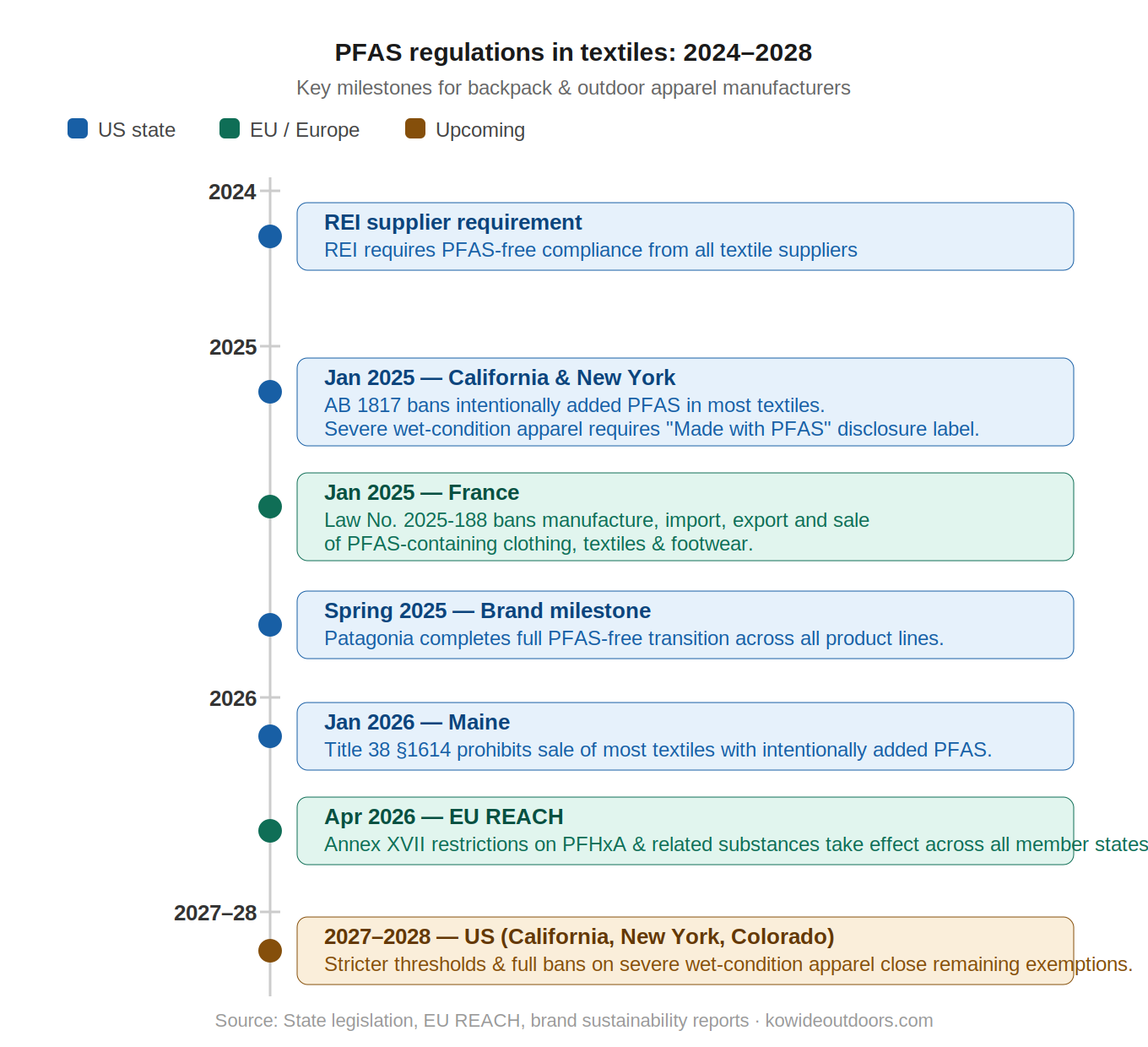
For backpack manufacturers and brands, the practical implication is clear: any product entering the US or EU market should be specified with PFAS-free DWR from the outset. The performance gap between fluorinated and fluorine-free treatments has continued to narrow, and the compliance risk of using PFAS is no longer worth the trade-off.
PFC-free DWR options for backpacks
Current PFC-free DWR technologies:
C0 (carbon-zero) DWR: most widely adopted; good performance, bluesign compatible
Bio-based wax treatments: natural origin, excellent for canvas and hemp fabrics
Silicone-based coatings: high durability, good for technical outer fabrics
Polymer-based DWR: strong initial repellency, improving wash durability
One honest trade-off remains: fluorine-free DWR can be less durable against abrasion, oil contamination, and repeated washing compared to legacy PFAS treatments. Setting realistic performance expectations for the intended use case and communicating them to end customers are part of responsible product development in 2026.

Certifications that matter
Global Recycled Standard (GRS)
The gold standard for recycled content claims. Covers chain of custody, social and environmental processing requirements, and chemical restrictions. Required by most major brands for rPET and rNylon claims.
bluesign®
Focuses on responsible manufacturing processes. Covers chemical safety, resource efficiency, and worker protection throughout the textile supply chain. A bluesign-approved fabric is a strong signal of process integrity.
GOTS (Global Organic Textile Standard)
The benchmark for organic natural fibers. Covers organic cultivation, responsible processing, and social criteria. Relevant for organic cotton and linen fabrics.
OEKO-TEX Standard 100
Tests for harmful substances in finished textiles. Useful as a baseline safety certification, though it doesn't address production-level environmental impact.
Cradle to Cradle Certified™
The most holistic certification, assessing material health, recyclability, energy, water, and social fairness. Still rare in backpack fabrics but increasingly requested by premium brands.
Practical sourcing considerations
MOQs remain higher for sustainable fabrics.
While the gap is closing, eco-certified materials often carry higher minimum order quantities than conventional equivalents. Planning ahead, consolidating orders, and building supplier relationships over time are essential for managing this.
Lead times can vary.
Some recycled and bio-based materials have longer or less predictable lead times than conventional fabrics, particularly for newer innovations like bio-based nylons. Build a buffer into your development calendars.
Documentation is non-negotiable.
Your customers, retail partners, and certification bodies will want to see the chain of custody. Work with mills that can provide full material traceability from raw input to finished fabric roll, and make sure your manufacturer can carry that documentation forward.
Durability is your best sustainability argument.
Across all materials, the single greatest lever for reducing environmental impact is product longevity. A well-constructed bag from rNylon that lasts 15 years is almost always more sustainable than a cheaper, less durable alternative, regardless of what's on the certification label.
Where the industry is heading
The direction of travel is clear. Regulatory pressure in the EU and US, consumer demand in North America and East Asia, and retailer sustainability requirements are all pushing the industry toward higher recycled content, PFAS-free chemistries, and greater end-of-life circularity. The PFAS transition, already largely complete for major brands, will ripple through mid-market and private-label production over the next two years as the 2027 and 2028 deadlines approach.
Brands that get ahead of this shift now, by investing in material knowledge, supplier relationships, and product design for disassembly, will be significantly better positioned as compliance requirements tighten.
At Kowide Outdoors, we believe that sustainability and performance are not in tension. Our role as a manufacturer is to help our clients navigate this landscape with clarity, honesty about trade-offs, and the production expertise to bring sustainable concepts to life at scale.
Ready to spec your next sustainable bag?
Our sourcing and product development teams work directly with brands to identify the right sustainable fabrics for their specific performance, certification, and cost requirements.

Kowide Outdoors – Who We Are
We specialize in OEM backpack manufacturing, technical outerwear production, and Vietnam-based supply chain solutions for global brands. from Taiwan, operating as both a custom backpack manufacturer and a trusted outerwear manufacturer for global brands.
A leading OEM manufacturer with over 50 years of experience supplying products to world-renowned brands across Europe, Asia, Australia, and North America. Our world-class production facility in Vietnam, situated within easy reach of Ho Chi Minh City, is ideally suited to cover all manufacturing needs, from R&D, sourcing, and prototyping to bulk production.
Through technical expertise, ethical management, and rigorous quality control, Kowide Outdoors consistently strives to exceed client expectations, taking pride in helping clients succeed by delivering the highest quality and unparalleled customer service.